



Introduction
Despite the rapid rise of cloud-native CRM platforms, Oracle Siebel CRM continues to remain relevant in 2026 for many large enterprises, particularly in industries such as automotive, telecom, and BFSI. Its deep functional capabilities, high level of customization, and ability to support complex business processes make it difficult to replace outright. However, its relevance today is not as a standalone system, but as part of a modernized, hybrid CRM ecosystem. This article provides a practical perspective on where Siebel stands today, the challenges it presents, and how enterprises can extract continued value while evolving toward modern architectures.
Siebel CRM’s Relevance Over the Years
Oracle Siebel CRM was once the gold standard for enterprise customer relationship management. Built for large-scale, complex organizations, it enabled deep process customization across sales, service, and partner management.
Over time, the CRM landscape has shifted toward cloud-first platforms such as Salesforce and Microsoft Dynamics 365, which offer faster deployment, continuous updates, and integrated ecosystems. These platforms prioritize agility, user experience, and scalability.
However, many enterprises still run mission-critical operations on Siebel due to its stability and the significant investment made over years of customization. As a result, organizations today do not simply replace Siebel. Instead, they are reevaluating its role within a broader digital architecture.
Challenges Posed by Siebel CRM: Why Don’t Enterprises Replace It?
Enterprises operating Siebel CRM face a set of persistent and evolving challenges.

1. High Cost of Ownership: On-premise infrastructure, licensing, and specialized skill requirements increase operational costs.
2. Limited Agility: Enhancements and changes often require longer development cycles compared to modern low-code/cloud platforms.
3. User Experience Gaps: Compared to modern CRM interfaces, Siebel’s UI can feel outdated, impacting adoption and productivity.
4. Integration Complexity: Connecting Siebel with modern digital platforms, APIs, and customer data ecosystems can be complex.
5. Talent Constraints: The availability of skilled Siebel developers and administrators is declining.
Despite these challenges, replacing Siebel entirely is often high-risk, high-cost, and disruptive, especially in enterprises where it supports deeply embedded business processes.
Maintaining Siebel CRM’s Relevance in an Enterprise IT Landscape
The practical approach in 2026 is not a binary decision of “retain vs replace,” but a strategic modernization of Siebel’s role.
1. Retain Core, Modernize Experience: Keep Siebel as the system of record for complex processes while layering modern UI/UX and digital interfaces on top.
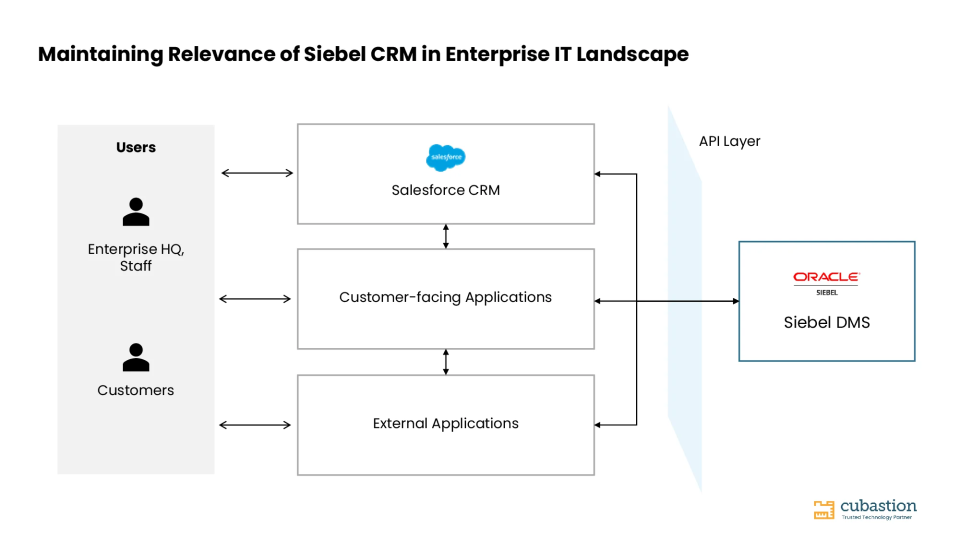
2. API-Led Integration: Expose Siebel functionalities through APIs, enabling integration with digital channels, mobile apps, and external systems.
3. Hybrid CRM Architecture: Adopt a multi-platform strategy where Siebel coexists with cloud CRM solutions, each serving specific use cases.
4. Incremental Modernization: Refactor high-impact modules or migrate select functionalities rather than attempting a full-scale replacement.
5. Data-Centric Approach: Position customer data in a centralized platform (CDP or data lake) to reduce dependency on Siebel for analytics and personalization.
This approach allows enterprises to preserve existing investments while enabling innovation.
How Cubastion Helps Ensure Siebel Continuity for Automotive OEM
Cubastion has been a strategic partner in enabling a large automotive OEM to continue running its dealer management and aftersales processes on Siebel CRM due to its deep customization and integration with external systems.
Instead of replacing Siebel, the organization implements a Siebel as the backend system of record for order management, warranty processing, and service workflows. The landscape further includes other technologies, including for CRM, and a modern digital layer. Customer interactions are powered by a modern front-end framework. These interfaces communicate with Siebel via APIs, enabling real-time access to service history, booking systems, and customer data. AI-driven chatbots are added to enhance personalization suggesting service packages, maintenance reminders, and upgrade options.
Dealers also benefit from a simplified interface that abstracts Siebel’s complexity while retaining its functional depth.

Impact Observed:
- Improved customer experience without disrupting core systems
- Reduced dependency on legacy UI
- Faster rollout of new digital features
- Lower risk compared to full CRM replacement
- Extended lifecycle of Siebel investments
This use case demonstrates that Siebel’s relevance lies not in competing with modern CRM platforms, but in serving as a stable core within a composable architecture.
Outcomes of a Modernized Siebel Strategy
A modernized Siebel strategy delivers balanced outcomes.

Operational Outcomes
- Continued stability of mission-critical processes
- Reduced disruption to business operations
- Optimized cost through selective modernization
Customer Experience Outcomes
- Improved usability through modern interfaces
- Seamless omnichannel interactions
- Enhanced personalization through integrated data layers
Business Outcomes
- Faster time-to-market for digital initiatives
- Better ROI on existing CRM investments
- Strategic flexibility in future CRM evolution
Enterprises shift from “legacy dependency” to controlled modernization.
Learning
Enterprises evaluating Siebel CRM in 2026 should consider the following best practices.
1. Avoid Binary Decisions: Full replacement is not always necessary or practical.
2. Focus on Business Value, Not Technology Trends: Retain what works; modernize what limits growth.
3. Invest in Integration and APIs: This is the key enabler of hybrid architectures.
4. Prioritize User Experience Improvements: Modern UX can significantly improve adoption without backend changes.
5. Plan for Gradual Evolution: Adopt a phased approach to modernization rather than large-scale transformation.
Siebel CRM is still relevant in 2026, but its role has evolved. Enterprises that treat it as part of a broader, composable CRM ecosystem will be best positioned to balance stability with innovation.
Contact Cubastion to build your Siebel strategy today.